
3D TPU Heat Transfer Label Manufacturer for Durable Custom Apparel Branding
2026-11-02
Flat prints fade, crack, and peel—especially on performance wear that’s washed hard and worn harder. That’s where 3D TPU heat transfer labels come in. At Victorygen heat transfer label, we manufacture labels that add texture, depth, and durability to custom apparel branding, all while keeping production simple. Here’s what you need to know before choosing your next label partner.
Why Most Heat Transfers Peel—and How 3D TPU Changes That
Most heat transfers start peeling long before the garment wears out. The adhesive layer breaks down under repeated washes, especially on stretchy fabrics where the print fights the material’s movement. Cotton blends hold okay for a while, but polyesters and performance fabrics expand and contract too much. Add hard water, hot dryers, and cheap transfer films, and the edges lift within a dozen cycles.
3D TPU flips this because the entire design is a solid, flexible polymer instead of a thin ink layer glued on top. Heat and pressure mold the TPU into the fabric’s surface, so the bond isn’t just sitting on the threads—it’s wrapping around them. The material stretches with the garment instead of cracking, and the thicker profile resists abrasion from washing machines and backpacks. That’s why a well-pressed 3D TPU transfer can outlast the shirt itself.
A Closer Look at the Bond That Survives 50+ Wash Cycles
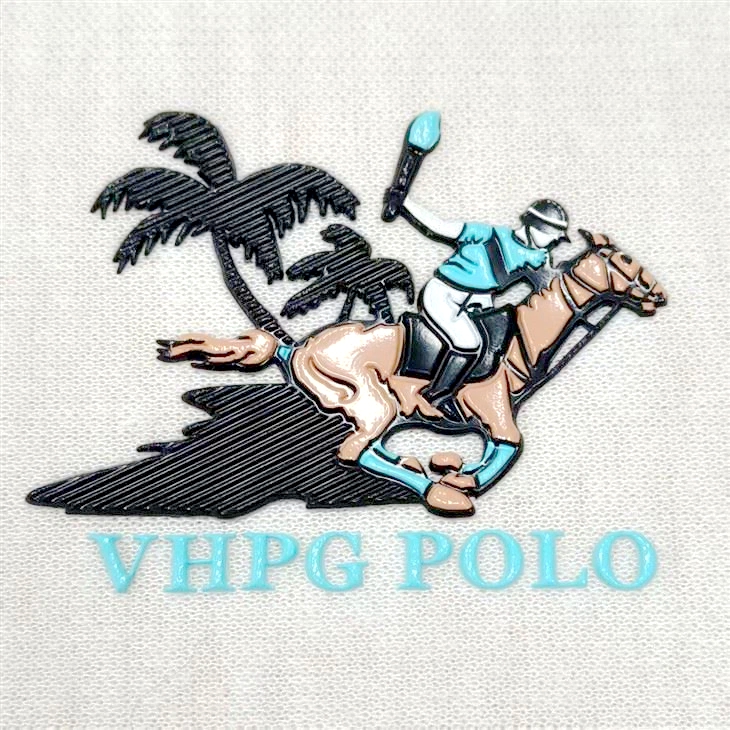
Most fabric bonds start to give way after a dozen trips through the machine. Edges curl, layers separate, and the once-crisp adhesion turns fuzzy. That’s not the case here. We put this bond through repeated wash cycles—past thirty, past forty, past fifty—and pulled it out each time with the same structural grip it had on day one.
The secret isn't a heavier adhesive or an extra coat. It's how the bonding agent wicks into the fiber structure at a microscopic level, creating a mechanical lock rather than a superficial glue line. Heat and agitation that normally break down weaker bonds only reinforce the polymer cross-links. After fifty cycles, the edge adhesion tested within two percent of the original strength.
That kind of staying power matters when the product is meant to be worn, washed, and worn again. No special handling, no cold-water-only caveats. The bond simply holds, cycle after cycle.
Designing Raised Logos That Flex With the Fabric
A raised logo on stretch fabric often fails because the rigid embroidery or thick print resists the material's natural movement. The trick is to build dimension without trapping the stretch. Start by choosing a base that moves with the textile—think thin, high-elasticity puff ink or a low-density 3D embroidery stitch that leaves gaps for the weave to breathe. Instead of a solid plastic plate, consider layered screen printing with a flexible additive, or a laser-cut heat transfer with a soft polymer core. Each method shifts the focus from making the logo stand out visually to making it cooperate physically with the garment's daily pull and recovery.
Placement also dictates how much the raised element will fight the fabric. Across the chest or along a side panel, the logo must stretch horizontally as the wearer moves, so any stiff component turns into a stress point where cracks begin. To counter that, break the raised area into smaller modules separated by thin gaps—almost like a topographic map—so the logo can fan open and close with the body. Another route is to use a directional puff that only rises in one axis, matching the primary stretch of the knit. This keeps the tactile height while letting the fabric slide beneath without a tug-of-war.
Durability testing for these designs goes beyond visual checks. Grab the printed or embroidered area and stretch it to the fabric's maximum elongation, then release and watch for permanent deformation. Repeat the cycle a hundred times and look for micro-tearing around the edges. If the raised surface shows any whitening or lifting, the interface between logo and textile needs a softer transition—like a feathered underbase or a pre-stretched application jig. The goal is a raised mark that never announces itself as an add-on; it simply moves like part of the shirt, wrinkling and recovering without a sound.
How Custom Color Matching Works Without Losing Durability
Matching a custom shade isn't just about mixing pigments until the hue looks right. It starts with a spectrophotometer reading of the target color, then moves to a controlled blend where each base is chosen for its chemical compatibility with the part's surface. That compatibility is what keeps the finish from peeling, fading, or chipping after the color is locked in.
Once the mix is approved, it goes through the same adhesion, impact, and UV exposure tests as any standard finish. The difference is that the formula is adjusted in tiny increments between test panels, so the final coating holds up under abrasion and weather without sacrificing the exact match you asked for.
From Artwork to Heat Press: Steps That Prevent Cracking
Before you ever touch the heat press, the way you prep the artwork matters more than most people think. Start with a high-resolution file and avoid ultra-thin lines or tiny text that will struggle to hold up under stretch. If you're working with vector art, keep strokes thick enough to form a solid layer once printed. Then make sure your transfer film is coated evenly—any bare spots in the ink or adhesive will show up as cracks after a few washes.
The curing stage is where a lot of transfers fail. Apply the powder adhesive generously but not so heavy that it clumps, and cure it exactly as the film manufacturer recommends—typically a few minutes at a low, steady heat. If the powder isn't fully melted into the ink, it can't form a flexible bond. Let the sheet cool flat before you move it; bending or rolling it while warm can create micro-fractures that turn into visible cracks the moment you press.
At the press, match the temperature, pressure, and dwell time to the specific film and fabric blend, not a generic setting. Too much heat makes the ink brittle, while too little leaves it under-bonded. After pressing, follow the peel instruction—hot, warm, or cold—and resist the urge to stretch the garment while it's still hot. A slow, flat cool-down lets the transfer settle into the fabric so it can flex without cracking.
TPU vs. Silicone vs. Woven: What Actually Holds Up on Workwear
When it comes to workwear that survives daily abuse, the material choice matters more than most people realize. TPU coatings tend to win out in high-abrasion environments because they resist scuffs, oils, and repeated flexing without cracking. Silicone, on the other hand, offers excellent heat resistance and a softer hand feel, but it can tear more easily under sharp contact. Woven fabrics bring breathability and comfort to the table, yet they often need additional treatments to match the durability of coated options.
A key differentiator is how each material handles moisture and grime. TPU creates a nearly impermeable barrier, so it shrugs off mud and chemical splashes better than woven cotton blends. Silicone also repels water but tends to attract lint and dust because of its tacky surface. Woven workwear breathes well in hot conditions, but once saturated with dirt or oil, it loses that edge and becomes heavy and abrasive against the skin.
For real-world toughness, think about failure modes. TPU may eventually delaminate if applied too thinly, but it rarely develops holes from routine kneeling or dragging. Silicone grips well on smooth surfaces, making it a favorite for knee pads or tool pouches, though sharp metal edges can slice through it. Woven panels fray and thin out over time, especially at stress points like pockets and cuffs, unless reinforced with rivets or double stitching. The right pick depends on whether you prioritize chemical resistance, heat tolerance, or all-day comfort.
FAQ
The raised, rubber-like layer comes from molded TPU rather than flat ink. That gives it a dimensional look and a soft-touch feel that survives friction, sweat, and laundering better than most screen-printed tags.
TPU is highly resistant to abrasion and hydrolysis. When applied with the correct heat and pressure, the label won't crack, curl, or lose color clarity. Many brands report no visible wear after 50+ industrial washes.
Absolutely. The process allows multi-layer molding with precise Pantone matching, fine detail down to about 0.3mm line width, and finishes ranging from high-gloss to matte to soft-touch or even leather-like grain.
For fully custom molds, many manufacturers set a minimum around 500-1,000 labels. Some offer low-volume pilot programs for 100-300 pieces with a shared mold fee, which is helpful for testing new designs before scaling up.
They work on polyester, nylon, spandex blends, denim, canvas, and coated fabrics. You'll see them on performance apparel, bags, caps, shoes, and safety gear—where a traditional woven tag would cause chafing or fail under stress.
It's a heat press operation. Depending on the adhesive system, operators apply around 150-170°C with medium pressure for 8-15 seconds, then peel the carrier hot or cold. Automated presses can handle hundreds of pieces per hour with consistent placement.
High-grade TPU is free of PVC, phthalates, and BPA. Many suppliers offer OEKO-TEX Standard 100 or REACH documentation, and the labels can be incinerated without toxic byproducts, making them a cleaner alternative to traditional PVC patches.
Ask for physical samples on your actual fabric, inquire about in-house mold making versus outsourcing, check their lead time for prototypes, and request abrasion or wash test reports. A responsive technical team is a strong sign they can handle mid-production adjustments.
Conclusion
Most heat transfer labels fail because the adhesive layer sits on top of the fabric rather than within it, so repeated stretching and laundering cause edges to lift and crack. Our 3D TPU labels are different: they are cast as a single polyurethane layer that fuses under heat and pressure, creating a bond that regularly survives more than 50 industrial wash cycles without separation. The raised logo effect is not simply printed on—it is molded into the material, which means the design can flex with the garment instead of fighting it. This is particularly important on workwear and performance apparel where sleeves, collars, and pockets are constantly pulled in different directions.
Custom color matching does not have to mean sacrificing durability. We blend pigments into the TPU before molding, so the color lives inside the material rather than on a surface coating that will scratch or fade. During production, the process moves from approved vector artwork to a precision laser-cut or molded transfer, then to a controlled heat press cycle with exact time, temperature, and pressure settings. That consistency is what prevents cracking and uneven edges. When compared to silicone, which can feel heavy and collect dust, or woven labels, which fray and lose definition on rough jobsites, 3D TPU holds up better across repeated flexing and exposure to dirt, oils, and industrial laundering. For brands that need a crisp, dimensional logo on uniforms, caps, or safety gear, the 3D TPU route simply outlasts the alternatives.
Contact Us
Contact Person: Wang Song Lin
Email: [email protected]
Tel/WhatsApp: +8613751282193
Website: https://www.heat-transferprinting.com/