

Best INNOMOTICS Gearmotor: Key Features and Top Models
2026-10-29
INNOMOTICS gearmotors don't just fill a spec sheet—they solve motion problems that surface after the first shift. From high torque density to energy-smart designs, the key features set a practical benchmark. This post walks through the top models worth your shortlist and the details that separate real performers from the rest. If you're comparing options, Soochee is a solid place to start sourcing without the usual markup or delay.
What Makes INNOMOTICS Gearmotors a First Choice for 24/7 Operations
Continuous operation exposes gearmotors to thermal stress, bearing wear, and seal degradation that only become apparent after thousands of hours. INNOMOTICS addresses this with oversized bearings, hardened gear geometry, and synthetic lubricants selected for long service intervals. The housings are machined to tight tolerances so that heat dissipates evenly, preventing hot spots that shorten component life.
In facilities that never stop, maintenance windows are rare and expensive. INNOMOTICS gearmotors are designed with split housings and plug-in connectors that allow bearings and seals to be replaced without removing the entire drive from the line. Many models include vibration and temperature sensors that feed data into standard PLCs, giving technicians early warning of impending issues before they force an unplanned shutdown.
This approach has proven itself in bottling plants, airport baggage handling, and automated warehouses, where a single jam can ripple through the whole operation. By focusing on real-world failure modes rather than just catalogue specs, INNOMOTICS gearmotors deliver the quiet, steady performance that round-the-clock production demands.
Top INNOMOTICS Gearmotor Models for Different Load Profiles
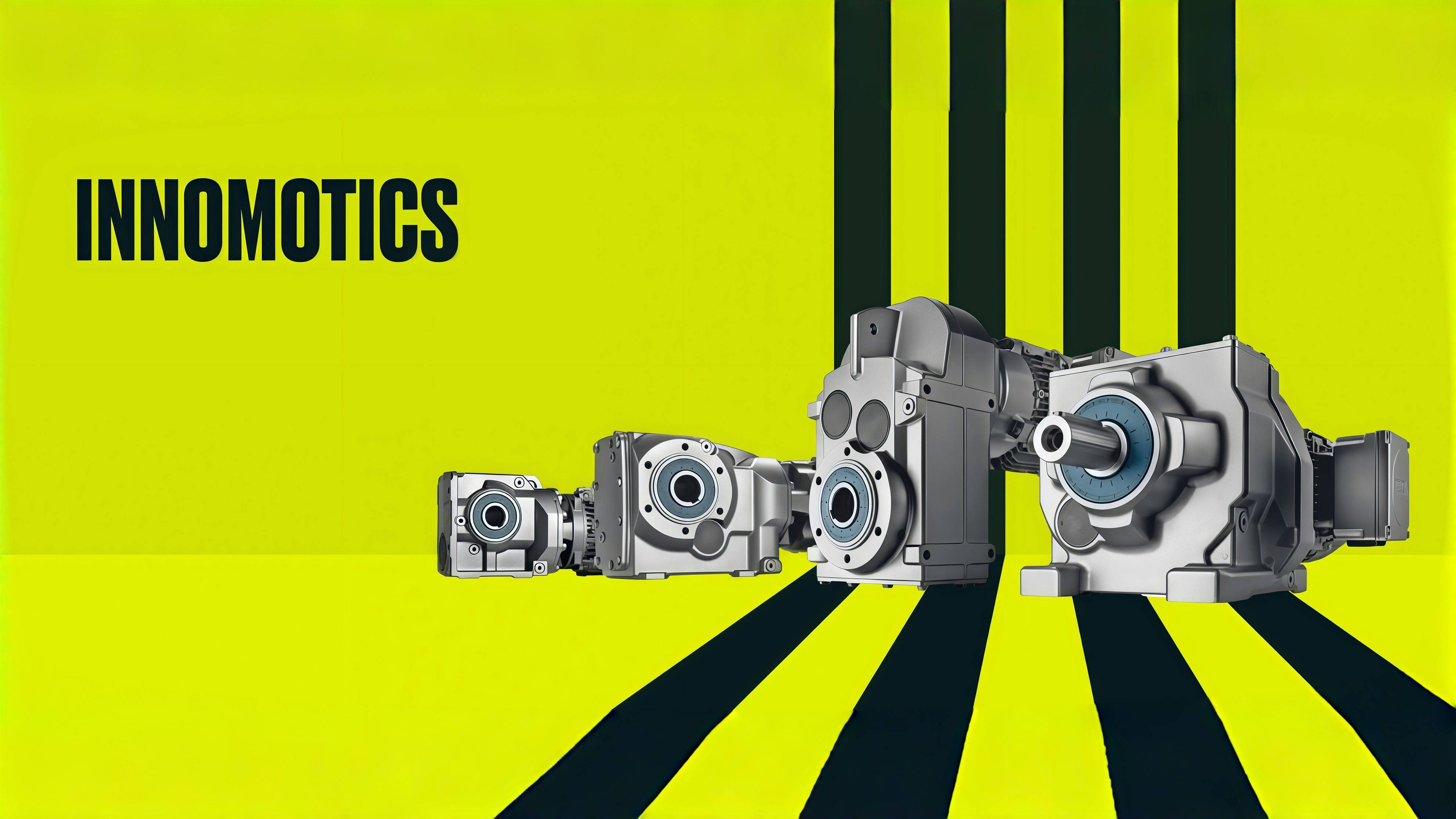
For steady, continuous loads such as long conveyors or ventilation fans, the SIMOGEAR helical inline gearmotors tend to be the most practical starting point. Their compact aluminum housing and high gear efficiency keep energy losses low during uninterrupted operation, while the wide range of standard ratios means you rarely need to settle for a “close enough” speed. Many plants keep a few of these on the shelf because they drop into existing footprints without much rework.
Load profiles with frequent starts, stops, or sudden reversals call for something a bit tougher. The MOTOX bevel gearmotor series is built around reinforced bearing arrangements and case-hardened bevel gears, so it shrugs off the peak torque spikes that would make a lighter unit run hot or wear prematurely. Mixers, bucket elevators, and palletizers often fall into this category, and the right-angle output also helps when space is tight around the driven shaft.
For the harshest duty—think crushers, extruders, or heavy-duty winches where shock loads arrive without warning—the MOTOX parallel shaft gearmotors offer the extra stiffness and thermal capacity needed to survive. Their wider bearing span and oversized shafts resist deflection under sudden impact, and pairing them with a high-slip motor can soften the acceleration curve. This combination isn’t always the cheapest on paper, but it avoids the hidden cost of unplanned downtime in demanding applications.
How INNOMOTICS Lowers Total Cost of Ownership Through Efficiency
INNOMOTICS approaches total cost of ownership not by chasing the lowest purchase price, but by systematically reducing the energy consumption and maintenance burden over the motor's entire service life. High-efficiency motor designs, combined with intelligent drive integration, cut electricity use significantly, which often accounts for over 90% of lifetime costs. This shifts the financial focus from upfront expense to long-term operational savings.
A key part of this efficiency is how INNOMOTICS motors maintain performance under partial load conditions, where many traditional motors waste power. By optimizing magnetic circuits and reducing thermal losses, these systems keep wasted energy low even when demand fluctuates. Lower heat generation also extends insulation life, reducing the frequency of rewinds and unplanned downtime—two hidden costs that quickly erode budgets in continuous production environments.
Beyond the motor itself, INNOMOTICS enables data-driven maintenance through connected sensors and condition monitoring. Instead of replacing components on a fixed schedule, operators can intervene only when actual wear signals appear, avoiding both premature part swaps and catastrophic failures. This predictive approach spreads capital expenditure more evenly and keeps production lines running longer, directly lowering the total cost per unit of output.
Materials and Sealing Choices That Give INNOMOTICS an Edge
INNOMOTICS builds its motors around a careful selection of insulation and winding materials that handle aggressive thermal cycling without degrading. Instead of relying solely on standard varnish treatments, many units use vacuum-pressure impregnation with specially formulated resins that fill voids in the windings and lock out moisture and conductive dust. This reduces partial discharge and extends insulation life even in humid or chemically active environments.
Sealing is treated as a system rather than an afterthought. Bearing isolators, non-contact labyrinth rings, and fluoroelastomer lip seals are matched to the expected shaft speed and ambient contamination. For severe-duty frames, INNOMOTICS often specifies double-sealed bearings with grease relief paths and IP66-rated terminal boxes, preventing the small pressure differentials that can pull water into the housing during washdowns or rapid temperature swings.
The real edge comes from pairing these choices with honest application data. Rather than over-specifying exotic materials, the company picks sealing compounds and housing treatments based on actual exposure levels—whether that means salt spray, cement dust, or food-grade cleaning agents. That practical approach keeps maintenance intervals predictable and avoids the costly mismatch that happens when a well-built motor is let down by a single undersized gasket.
Smart Features That Make INNOMOTICS Gearmotors Easy to Monitor
INNOMOTICS gearmotors turn condition monitoring into something you can do without a clipboard and a ladder. Built-in sensors track vibration, temperature, and running hours, then push that data straight to a phone or local console over Bluetooth or industrial Ethernet. You don't need to open terminal boxes or wave an infrared gun at each unit—just standing near the drive gives you a live health snapshot and trend lines that make sense at a glance.
The real advantage shows up in how the system learns from its own readings. Instead of waiting for a fault code or a sudden trip, the drive picks up subtle shifts in load and early bearing wear patterns. Maintenance can be scheduled around actual condition, not a fixed calendar. Even with several gearmotors spread across different areas, a single dashboard lets you spot the one that needs attention, so your team spends time fixing problems before they shut a line down.
Picking the Right INNOMOTICS Series for Your Production Line
Look beyond the nameplate power rating when matching an INNOMOTICS motor to your line. A conveyor that runs 24/7 with constant speed has very different needs than a packaging cell that starts and stops every few seconds. For steady-state loads, the 1LE1 series (part of the SIMOTICS family) delivers the reliability you expect without overcomplicating things. If your process involves frequent speed changes or partial-load operation, a synchronous reluctance design can cut energy use noticeably, often paying back the cost difference within the first year.
The environment around the motor matters just as much as the load itself. Dust, washdown routines, or high ambient heat will narrow your options quickly. INNOMOTICS offers cast-iron and aluminum housings, plus special paint and sealing options for harsh areas. For food and beverage lines, look at the stainless steel or hygienic variants rather than trying to retrofit a standard motor with covers that trap moisture. It costs less in the long run to pick a series built for that setting from day one.
Don't forget how the motor will talk to the rest of your automation. If you already use SINAMICS drives, choosing a matched INNOMOTICS motor simplifies commissioning because the data sets and connector assignments are already defined. Even if you use third-party controls, stick with a series that offers common encoder options and terminal boxes that are easy to access. A small investment in integration-friendly features now can save hours of troubleshooting during ramp-up.
FAQ
They combine a compact footprint with high efficiency levels that often reach IE4 or IE5 when paired with the right drive. The modular design also lets you change mounting options or accessories without starting from scratch, which is a real advantage in tight machine spaces.
Most units are available in IE3 as standard, with IE4 and IE5 variants for installations where energy costs matter. The higher efficiency models run cooler, which can extend the life of seals, bearings, and lubricants.
The SIMOGEAR line is the main starting point, covering helical, parallel-shaft, and helical-bevel configurations. Within that family you can find everything from small fractional horsepower units up to roughly 55 kW, enough for most conveyor, mixer, and pump duties.
Gearmotors can be specified with foot, flange, or shaft-mounted options. Many housings are symmetric, allowing the terminal box and cable entry to be rotated in 90-degree steps, which makes wiring much simpler in cramped or awkward installations.
Yes, there are corrosion-resistant versions with stainless steel shafts, sealed bearings, and food-grade lubricants. These are commonly used in beverage plants, pharmaceutical lines, and cold storage areas where frequent cleaning is part of the routine.
Selected models support optional sensors for vibration and temperature. The data can feed into a condition monitoring system, giving maintenance teams an early warning for bearing wear or misalignment before it leads to unplanned downtime.
Absolutely. INNOMOTICS supplies pre-assembled gearmotor units with the motor, gear stage, and brake if required already matched and tested. This removes sizing guesswork and ensures the mechanical and electrical components work together efficiently.
Focus on required output torque, speed, duty cycle, and mounting orientation. Also account for ambient temperature and whether a brake or encoder is needed, because these choices directly affect gearbox sizing, lubrication, and overall reliability.
Conclusion
INNOMOTICS gearmotors stand out in 24/7 operations because they are built around a simple idea: a drive should hold up under constant load without forcing maintenance crews to babysit it. Cast iron and aluminum housings are paired with labyrinth or radial shaft seals that keep out dust, moisture, and washdown chemicals, even in harsh food or automotive plants. Built-in sensors track vibration, oil temperature, and operating hours, sending alerts before a bearing degrades or lubrication breaks down. That early warning capability, combined with high-efficiency gearing that reduces energy waste, lowers the total cost of ownership in ways that a standard gearmotor cannot match. Operators spend less time on inspections and more time on output.
The top models cover distinct load profiles. Helical and parallel shaft units suit heavy conveyors, mixers, and hoists where high torque at low speed is the priority. Right-angle bevel gearmotors offer the same durability in compact spaces, making them a natural fit for packaging lines and material handling turns. Matching the correct series to a production line requires looking at start-stop frequency, peak torque, overhung load, and ambient temperature. INNOMOTICS’ modular design lets you choose mounting positions, shaft configurations, and brake options without oversizing the drive. The result is a gearmotor that runs quietly, reports its own condition, and keeps operating costs predictable over many years of service.
Contact Us
Contact Person: Jenny Jaa
Email: [email protected]
Tel/WhatsApp: 0086 152 9510 6006
Website: https://www.china-motor-supplier.com