

Best Small Magnet: A Practical Guide to Tiny Powerful Magnets
2026-08-31
A magnet no bigger than a coin can do a surprising amount of work—if it’s built right. That’s the focus of this guide: separating genuinely strong small magnets from the cheap imitations that look the part but fail under real use. You’ll learn what to check in size, coating, pull force, and shape, and why brands like DAWA are worth a closer look when you need compact power without guesswork.
What Makes a Magnet Smaller Than a Coin So Shockingly Strong
When you hold a magnet no bigger than a dime and it clings to a fridge with surprising force, the secret isn't in its size but in the precision of its atomic arrangement. Ordinary magnets have countless tiny magnetic domains pointing in random directions, canceling each other out. But this tiny powerhouse is built from a special recipe that lines up nearly all those domains in the same direction, allowing it to pack an extraordinary magnetic punch into a miniature frame.
The real game changer is the material itself—usually a neodymium-iron-boron alloy. Neodymium atoms possess an unusually high magnetic anisotropy, meaning they strongly prefer to stay magnetized along a specific axis. During manufacturing, the powdered alloy is pressed in a magnetic field, forcing each microscopic grain to align its easy axis the same way. Add to that a carefully engineered grain boundary phase that prevents demagnetization from creeping in, and you get a magnet that maintains near-saturation even when it's only a few millimeters thick.
What truly sets these tiny magnets apart is how they resist losing their strength. Through controlled heat treatment and the addition of elements like dysprosium or terbium at the grain boundaries, manufacturers create a shell that blocks reverse magnetic domains from nucleating. This means the magnet can stay fiercely magnetized under conditions that would weaken ordinary magnets. The result feels almost supernatural: a fragment smaller than a coin can lift hundreds of times its own weight, not because it breaks physical laws, but because it exploits them with remarkable efficiency.
Neodymium or Ceramic for Tiny Magnets That Won't Quit
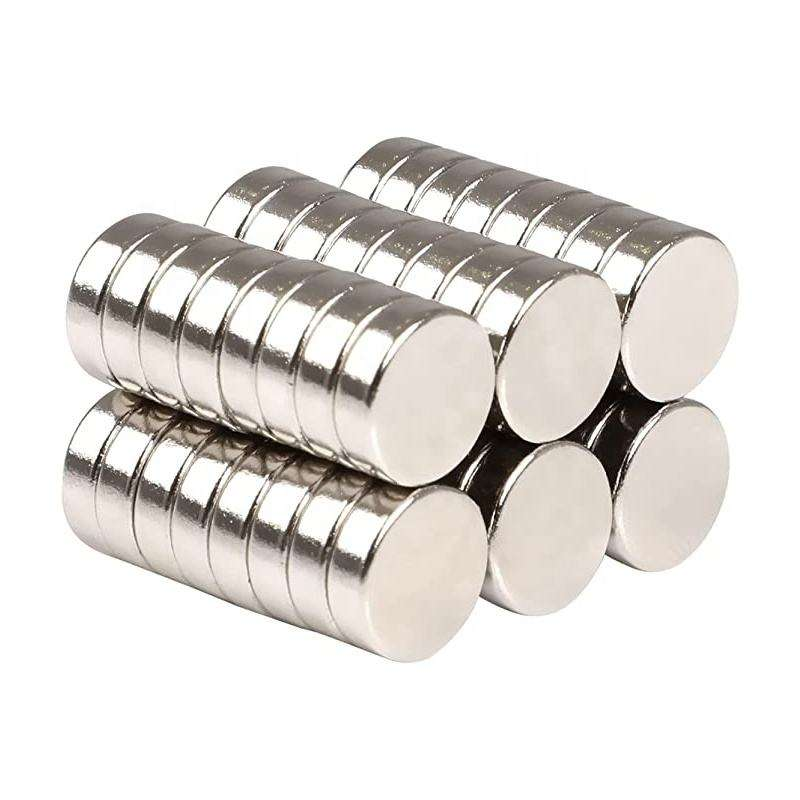
For a magnet that has to keep pulling after years of use, material choice matters more than size. Neodymium packs a serious punch in a very small package, so it often wins when you need a strong hold from limited space. However, that power comes with a tendency to corrode if the coating wears thin, and it can lose strength faster when things heat up beyond its comfort zone.
Ceramic, on the other hand, isn't nearly as strong for the same dimensions, but it shrugs off moisture and mild chemicals without any protective layer. If your tiny magnet lives outdoors or inside a damp enclosure, ceramic may actually be the one that won't quit, because there's no plating to flake off and no oxidation to undermine the field.
So the real question isn't which one is "better" but what kind of quitting you're worried about. Tiny neodymium magnets deliver extreme grip until they degrade; tiny ceramic magnets deliver moderate grip that stays steady for decades. Match that trade-off to the actual environment, and you'll get a magnet that lasts as long as the device it's built into.
How to Read Pull Force Specs Without the Guesswork
Pull force specs often look like a foreign language if you're not used to reading them. The first thing to remember is that these numbers are rarely absolute—they come from specific test setups, usually involving a flat steel plate and a particular air gap. If you don't know the test conditions, the number means almost nothing. So before you compare two magnets, check whether the stated pull force was measured with a 1mm gap, direct contact, or something else entirely. This single detail can easily cause a 50% difference in the reported value.
Another trap is assuming pull force scales linearly with size or grade. A magnet that's twice as thick doesn't simply double in pull force—the relationship follows the square of the magnetic flux density, which itself depends on the magnetic circuit. For the same grade, adding thickness has diminishing returns beyond a certain point because the extra material is too far from the target surface. Instead of chasing a bigger number, look at the actual application: if you're lifting through a gap or a non-magnetic spacer, the effective pull force drops sharply. A quick way to sanity-check a spec is to compare it against known reference points, like a standard N42 disc of similar diameter.
Finally, treat every manufacturer's number with a healthy dose of skepticism unless they include the test method and tolerance. Pull force specs are often given as a maximum or average without any stated variance. Real magnets have surface imperfections, plating variations, and slight dimensional tolerances—all of which can knock 10-20% off the ideal value. If you need a reliable figure, either ask for a batch-specific test report or build in your own safety factor of at least two. That way, you're not guessing; you're engineering based on real-world behavior rather than a marketing sheet.
Everyday Jobs Where a Pocket-Sized Magnet Saves the Day
In auto repair shops, a tiny neodymium magnet tucked into a shirt pocket is the unsung hero. When a bolt vanishes into the engine bay, it's not the flashlight that finds it first—it's the magnet swept along the frame rails. Mechanics rely on it to fish out dropped sockets, retrieve metal shavings from tight spots, and even hold a wiring harness temporarily in place while both hands stay busy. Without this pocket-sized tool, a ten-minute fix can turn into a forty-minute treasure hunt.
Electricians working inside junction boxes face a similar chaos. A steel screw slips from the screwdriver and disappears into a nest of cables. Instead of dismantling the entire box, they slide a small magnet along the edges until it clicks against the runaway screw. It also helps separate ferrous and non-ferrous connectors during panel upgrades, and in older buildings, it's the fastest way to trace metal conduit paths behind plaster without ripping open walls.
Carpenters and drywall installers keep a magnet in their nail pouch for more than just cleanup. After a demolition pass, a quick sweep of the floor pulls hidden nails and staples that could puncture a shoe or ruin a new subfloor. On ladders, when a hinge pin or cam lock nut drops, the magnet on a string becomes a third hand. It's the difference between climbing down six times an hour and staying in the work flow.
Keeping Your Fingers Safe Around Powerful Little Magnets
A pair of tiny neodymium magnets can snap together with surprising force, and if your fingertip happens to be in the way, the result is often a deep pinch, a blood blister, or even a small crush injury. The danger isn't just the pull strength on paper; it's the speed at which these magnets close the gap. Keeping your hands out of that closing path is the single most important habit to build.
When separating two stuck magnets, don't try to pry them apart with your fingernails or by gripping the edges. Instead, set one magnet on a non-metallic surface and use a wooden or plastic wedge to slide them apart laterally. If you must handle them directly, wear thick work gloves and keep your fingers well away from the mating faces. A sideways push is much safer than a straight pull because it gives you more control over the sudden release.
Storage also plays a big role in finger safety. Loose magnets in a drawer will find each other, or the nearest steel tool, often with a painful snap. Use individual compartments, plastic dividers, or non-magnetic spacers between larger pieces. And if a finger does get caught, don't panic and yank the magnet away; that can tear the skin. Cool the area under running water and assess the damage before deciding whether you need medical attention.
Spotting Quality Small Magnets Before You Click Buy
When you're shopping for tiny magnets, the first thing worth doing is checking the coating under good light. Cheap plating flakes quickly, leaving bare spots that rust and ruin whatever you're building. A quality small magnet usually has a uniform nickel-copper-nickel layer, no bubbles, no thin edges, and the surface feels slick rather than gritty.
Pull force claims only tell part of the story. Look for the actual grade, usually N35 to N52, and match that to the listed dimensions. A reputable seller will list real tolerance, not just strong. If the magnet is meant to hold something, test with a small steel plate or another magnet before committing to a bulk order.
Also pay attention to machining. Small magnets with clean chamfered edges and no visible cracks handle repeated use better. Brittle neodymium can chip if the edges are sharp or the sintering is poor. A quick visual check plus a gentle tap on a hard surface can reveal hidden fractures that photos hide.
FAQ
Strength usually depends on the neodymium grade. An N52 magnet is among the strongest commercial grades, so a tiny cylinder or cube can still hold a hefty stack of papers or a small tool.
Not always. They can snap together hard enough to pinch skin or crack if they collide. Keep them away from children and pets, and never swallow them because that can cause serious internal injuries.
You can hide them in cabinet doors as latches, attach spice jars to a metal shelf, build a slim phone mount for a car, or use them to keep sewing needles and pins in one place.
Discs offer a flat surface for gluing, cubes are easy to align in a row, and spheres are fun for fidgeting or sculpting but roll away quickly and have less contact area.
Most neodymium magnets keep their strength for decades if you avoid high heat, strong opposing magnetic fields, and physical damage. Heat above the rated working temperature can permanently weaken them.
Look for a clear grade such as N42 or N52, a listed pull force, and a protective coating like nickel-copper-nickel. Also confirm the actual dimensions in both metric and imperial units if you are matching an existing project.
Keep them separated in a divided container or stuck to a steel plate with spacers. If they arrive stacked, slide them apart sideways instead of pulling straight off to avoid pinching or chipping.
Conclusion
You don't need a magnet the size of your palm to get serious holding power. Modern tiny magnets, often no larger than a coin, pack astonishing strength because of the way neodymium alloys are formulated and shaped. Ceramic options still exist for high-heat or budget situations, but if you want something that won't quit, neodymium is usually the better pick. The trick is learning to read pull force specs without getting lost in marketing numbers. A listed rating only tells part of the story—what matters is the surface, thickness, and whether the magnet is pulling directly against a flat steel plate or trying to cling to a rough edge. Once you understand those basics, a pocket-sized magnet can quietly handle jobs that used to require a tool bag. From retrieving dropped screws behind a workbench to holding a cabinet door shut, the right little magnet earns its keep.
Safety is just as important. A tiny neodymium magnet can snap together with enough force to pinch skin or shatter if dropped, so keep them away from children and pacemakers, and slide them apart rather than pulling. When you shop, don't just choose the highest pull force. Look for a nickel-copper-nickel coating that resists chipping, check that the listed dimensions match the actual magnet, and favor vendors who give clear test conditions instead of vague claims. A few dollars more often buys a magnet that stays usable for years instead of flaking apart in a drawer. The best small magnet isn't necessarily the strongest one—it's the one that fits your hand, your project, and your tolerance for risk, while doing its job without fanfare.
Contact Us
Contact Person: Kelvin Lo
Email: [email protected]
Tel/WhatsApp: 0769-88561131
Website: https://dawamagnetic.com/