

China White Masterbatch: Essential Guide for Plastics Manufacturers
2026-10-19
White masterbatch is the quiet workhorse of plastics production—get it wrong, and every downstream product shows the flaw. Yet many manufacturers still treat it as a commodity buy, then wonder why opacity drifts or screws slip. This guide flips that script for China sourcing. You'll learn what separates premium white masterbatch from cheap filler, which specs actually predict performance, and how to avoid the batch-to-batch variation that kills margins. We also spotlight Xinwancai, a supplier that's redefining consistency in this space. Ready to turn an overlooked raw material into your competitive edge? Let's dive in.
What Actually Goes into a Quality White Masterbatch
Most people assume a white masterbatch is just titanium dioxide tossed into resin. That assumption falls apart the moment you run it through a film line and see lacing, poor opacity, or die build-up. The real difference starts with the pigment grade—rutile TiO2 with a tight particle size distribution and the right surface treatment—because untreated or coarse grades will scatter light unevenly and create a dull, grey cast. But even a premium pigment fails if the carrier resin doesn't match the let-down polymer. A polyethylene-based carrier in a polypropylene system often leads to poor dispersion and weak mechanical properties, so matching melt flow and chemistry matters more than most processors expect.
Beyond the obvious ingredients, a quality white masterbatch relies on a well-chosen dispersant package. This isn't just a "wetting agent" added at random; it has to lower the interfacial tension between TiO2 particles and the molten carrier without leaving residue that migrates to the surface later. The best formulations use a combination of low-volatility waxes and polar additives that hold the pigment agglomerates apart during compounding, then let them break down under normal screw shear. If this step is rushed or skipped, you'll notice it as micro-specks in thin-gauge film or uneven whiteness in injection-molded parts.
Finally, consistency separates a dependable white masterbatch from a batch-to-batch gamble. That means controlling filler content within a narrow range, screening out oversized particles, and monitoring volatiles to prevent moisture-related defects. It also means running the compound through a fine filtration mesh and checking melt flow stability, not just opacity on paper. When those behind-the-scenes details are handled properly, the masterbatch drops into the process without forcing adjustments to temperature or screw speed—and that's when white actually looks white.
Formulation Levers That Control Opacity and Dispersion
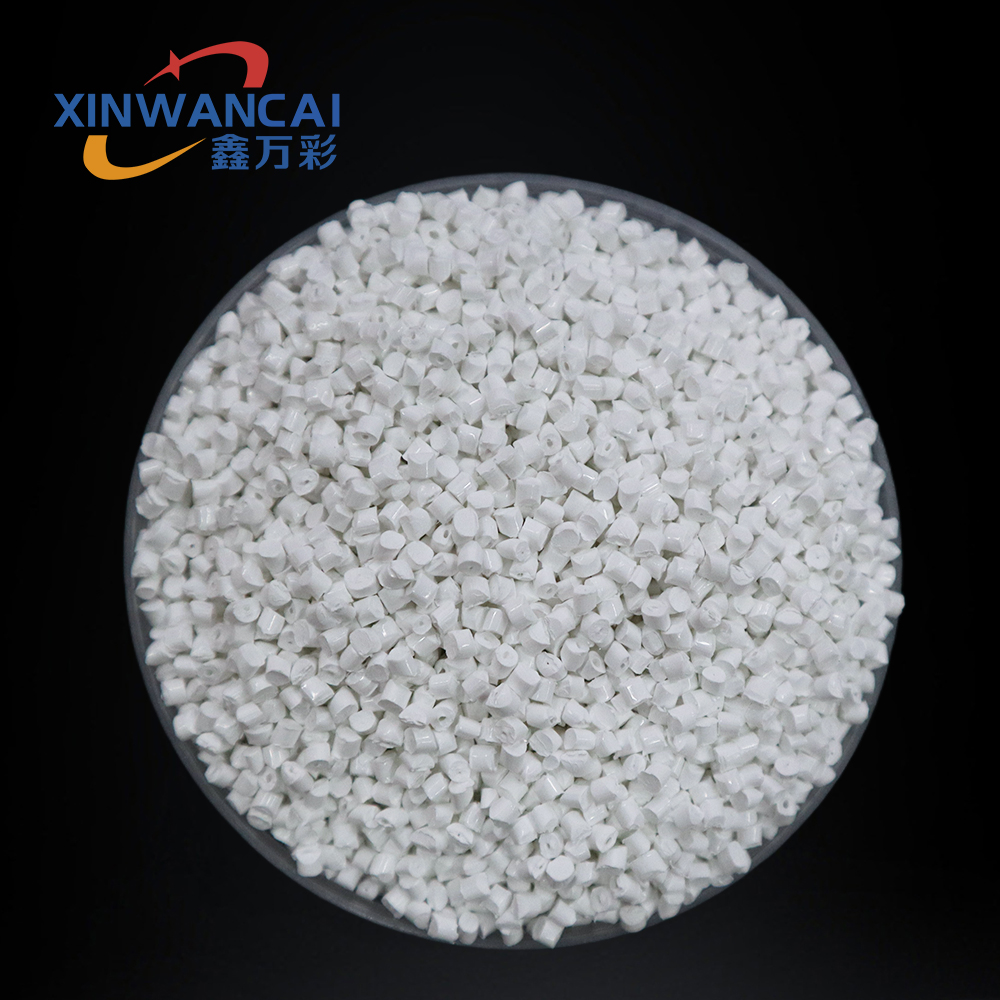
Pigment particle size and the width of its distribution do more to set opacity than almost any other variable. A narrow band around 0.2 to 0.3 micrometres tends to scatter visible light most efficiently, but pushing too fine or too coarse quickly undermines hiding power. The practical trick is to monitor grind energy and time rather than just aiming for a number on a gauge, because over-grinding can flatten the particle shape and actually increase transparency.
Dispersion stability hinges on the choice of wetting agent and its anchoring strength to the pigment surface. A dispersant that grabs loosely leaves particles free to flocculate later, which drags opacity down unevenly across a batch. Formulators often tune acid value or amine content to match the pigment's surface chemistry, and this has to survive temperature swings during storage, not just look good in a drawdown.
Beyond chemistry, the order of addition and let-down stage can override earlier gains. Adding resin too fast or under high shear can shock the mill base and force pigment back into aggregates. Slowing the let-down, or staging solvent and binder additions, preserves the particle separation achieved in grinding and keeps final film opacity from drifting.
Evaluating Chinese Suppliers Without Relying on Marketing Claims
When you step away from glossy brochures and polished sales pitches, a different picture of a Chinese supplier often emerges. Start by examining the physical details that marketing departments rarely control: the consistency of raw material batches, the wear patterns on production equipment, and the organization of the warehouse floor. A factory that keeps its cutting tools sharp and its inventory labeled with handwritten dates tends to value precision more than one that invests heavily in a booth at a trade show. Ask for a live video walkthrough without prior notice, and pay attention to how workers react—hesitation or confusion can reveal more than any certificate.
Documentation matters, but only when it can be traced to actual processes. Instead of accepting an ISO certificate at face value, request the internal audit records, non-conformance reports, and corrective action logs from the past twelve months. A supplier that openly shares a list of past defects and how they were fixed demonstrates a learning culture. Conversely, a spotless record often means either the audits are cosmetic or the problems are hidden. Cross-check the names on documents with the people actually doing the work—if the quality manager listed on paper has never walked the production line, that is a red flag no marketing campaign can erase.
Finally, test the supplier’s problem-solving reflex under pressure. Send a small trial order with a deliberate, minor specification change that requires adjustment mid-run. Watch how quickly they flag the issue, propose alternatives, and document the deviation. A supplier that silently corrects the error to avoid looking bad may be cutting corners elsewhere. The ones worth partnering with will contact you within hours, explain the trade-offs clearly, and ask for approval—not because they fear a bad review, but because they treat your product requirements as non-negotiable. This kind of honest friction is the clearest signal you are dealing with engineers, not just exporters.
Real-World Problems When White Masterbatch Underperforms
When a white masterbatch fails to deliver adequate hiding power in thin-gauge films, converters often see a blotchy, translucent finish. The film may show streaks or uneven whiteness, forcing operators to crank up the letdown ratio. That extra loading, however, can compromise the film’s tensile strength, create die build-up, and slow down line speeds due to higher melt viscosity.
In injection molding, poor dispersion of the white pigment shows up as surface blemishes—small white specks, flow lines, or a dull, chalky appearance on the part. These defects are not just cosmetic. Agglomerates act as stress concentrators, so a seemingly solid white housing can crack or fail under impact, leading to higher reject rates and customer complaints.
Heat history is another common trouble spot. If the carrier resin or the titanium dioxide grade lacks thermal stability, white parts may start to yellow after multiple processing cycles or during end-use exposure to heat and UV. This drift from bright white to off-white or even cream is especially damaging in applications like appliances, automotive interiors, or food packaging, where color consistency is non-negotiable.
Price Versus Performance Reading Between the Quotes
Many buyers assume a higher price automatically signals better performance, but that link is often looser than the sticker suggests. In markets from software to manufacturing, the quoted figure reflects positioning, brand overhead, or distribution margins just as much as raw capability. Reading between those numbers means asking what the seller chose not to print: support costs, failure rates, integration time, or the true cost of switching later.
Performance, on the other hand, rarely shows up cleanly in a single quote. Two components can carry identical specs yet diverge sharply under sustained load, temperature swings, or real-world tolerances. The gap between price and performance appears when a low-cost option quietly matches a premium label in the metrics that matter to your workflow, or when an expensive system demands hidden workarounds to hit its advertised numbers.
The practical move is to treat price as one data point, not a verdict. Pull apart the quote into lifetime cost, compare performance on your own benchmarks rather than vendor slides, and ask where the extra dollars actually go. Often the smartest buy sits in the middle: not the cheapest option that cuts corners, and not the flagship that charges for a name.
Incoming Inspection Routines That Keep Your Lines Stable
Most line stoppages traced back to incoming material share a common thread: the defect was visible before release, but nobody looked for it. A solid incoming inspection routine starts with matching the check sheet to the failure history of each part number. If a particular casting has shown porosity in three of the last five batches, that becomes a mandatory cut-up or X-ray check, not an optional note. This shifts the inspection from a generic gate check to a targeted screen that catches what actually disrupts your process.
Sampling plans need to reflect risk, not just the default AQL. High-mix, low-volume lines often receive small lots where a single bad unit can halt assembly for hours. In those cases, inspecting every critical dimension on the first piece and then tightening the frequency for the rest of the lot is more practical than pulling ten random parts and hoping. Pair that with clear labeled bins for accepted, quarantined, and rejected material, so a mixed lot never drifts into production by accident.
The routine should end with data, not just a pass/fail stamp. Record the actual measured values, the batch number, and the supplier's certificate if one exists. When a shift supervisor sees a trend creeping toward the tolerance limit, they can adjust upstream before the line feeds on borderline stock. This kind of feedback loop keeps incoming inspection from becoming a paperwork ritual and turns it into the first real control point for line stability.
FAQ
White masterbatch is a concentrated mixture of titanium dioxide or other white pigments dispersed in a carrier resin. It gives plastics a clean, opaque white color while avoiding the mess and health risks of handling loose pigment powders. Many manufacturers prefer it because it simplifies dosing, improves color consistency, and keeps production lines cleaner.
Chinese producers have invested heavily in modern compounding lines and often offer competitive pricing without sacrificing basic quality. That said, consistency can vary from one supplier to another, so it is wise to request samples, check certifications, and run a small trial before committing to large volumes.
Common thermoplastics like polypropylene, polyethylene, ABS, polystyrene, and PVC are all compatible with white masterbatch. The key is choosing a grade whose carrier resin matches the base polymer, otherwise you might see poor dispersion or delamination in the finished part.
Pay attention to titanium dioxide content, dispersion quality, heat stability, and batch-to-batch consistency. Ask for a technical data sheet and request a small sample for lab testing. Also check whether the supplier can provide documentation for RoHS, REACH, or other regulatory requirements relevant to your market.
Start with a low addition ratio and gradually increase it while checking for streaks or color shifts. Make sure the masterbatch is stored in a dry place and not exposed to high heat for long periods. If yellowing appears, discuss the carrier resin and antioxidant package with the supplier, since these can be adjusted for better thermal protection.
White masterbatch shows up in film, injection molding, blow molding, sheet extrusion, pipe, and fiber production. It is widely used in packaging, household appliances, automotive parts, toys, and everyday consumer goods where a bright, opaque white finish is needed.
If the carrier resin is compatible and dispersion is good, the impact on mechanical properties is usually minimal. Very high loading levels can slightly reduce impact strength or flexibility, so it is best to optimize the dosage rather than simply adding more to achieve extra whiteness.
A common range is 2% to 10% by weight, depending on the target opacity and whiteness. High-concentration grades may work well at 1% to 3%. Running a small gradient test on your own equipment is the most reliable way to find the right balance between cost and visual performance.
Conclusion
For plastics manufacturers sourcing white masterbatch from China, actual quality starts long before the first pellet hits the hopper. A dependable product hinges on the titanium dioxide grade and loading, the carrier resin’s melt flow match with your base polymer, and the precise blend of waxes and coupling agents that breaks down pigment agglomerates. Those formulation levers control opacity, tint strength, and dispersion, which in turn determine whether you get clean film, bright injection parts, or streaky scrap. Yet most supplier datasheets repeat the same vague promises. Instead of relying on marketing language, push for a disclosed formulation range, retained production samples, and real trial data under conditions close to your own. Check whether the supplier uses consistent TiO2 sources, virgin carrier resin, and stable twin-screw extrusion parameters. When these details are hidden, quality drift is almost guaranteed.
Underperformance usually appears as poor hiding power, plate-out on dies, screw slippage, filter pressure spikes, or visible specks in thin-gauge film. These failures trace back to insufficient TiO2, recycled carrier contamination, or incomplete dispersion. Price quotes alone reveal little: a lower per-kg figure can mean reduced pigment content, cheaper rutile substitutes, or a carrier that forces you to raise let-down ratios, erasing the apparent saving. Compare suppliers on cost per finished article at a fixed opacity and mechanical property target, not on raw masterbatch price. At incoming inspection, run melt flow index, ash content, XRF or TGA for TiO2 percentage, and a small extrusion trial with your production resin. Record filter pressure rise and visual defects under standardized settings. Keep a retained sample from each lot and tighten specifications the moment a line drifts.
Contact Us
Contact Person: JACK
Email: [email protected]
Tel/WhatsApp: 86 18650130917
Website: https://www.xinwancai.com/