

Custom Gantry Machining Center Solutions: Maximizing Accuracy and Productivity in Large-Scale Machining
2026-05-11
When machining massive components, every micron counts. Standard equipment often struggles to balance the rigid demands of large-scale work with the finesse required for tight tolerances. That’s where custom gantry machining centers step in—purpose-built to tame oversized parts without sacrificing speed or precision. In this post, we explore how tailored solutions from WINNRUI CNC are redefining what’s possible in heavy-industry machining, from aerospace structures to energy sector giants. Let’s dive into the engineering and strategy that turn these behemoths into paragons of accuracy.
Precision Beyond Standard Limits in Large-Scale Work
Large-scale projects have a way of exposing the hidden flaws in conventional precision standards. When a structure spans hundreds of meters or an assembly line churns out components by the thousands, tiny discrepancies that would otherwise go unnoticed begin to accumulate. The geometry of a bridge tower, for instance, might meet the typical tolerances on paper, yet under actual load conditions, millimeter-level deviations in early sections cascade into centimeters at the far end. This isn't just about meeting a spec sheet—it’s about understanding that standard limits rarely account for the compounding effects of scale.
Pushing precision beyond these limits demands a different mindset. It starts with rethinking measurement itself, moving away from isolated spot checks toward continuous, multi-point monitoring that captures how an entire assembly behaves in real time. Laser trackers, photogrammetry, and inertial navigation systems are often fused into a single feedback loop, allowing correction data to flow instantly to machining centers or positioning actuators. Equally critical is thermal compensation—a workshop floor might shift by a few degrees, but over a 50-meter workpiece, that alone can throw dimensions out of spec. The real breakthrough comes when teams stop treating environment and process as separate variables and instead design a closed-loop system where precision is actively maintained, not just verified after the fact.
What makes this level of control impactful is how it quietly changes the economics of large-scale work. Fewer reworks, less material waste, and tighter joints all add up to faster assembly sequences and longer service intervals. A precision-forged turbine shaft that integrates perfectly from the start doesn’t just perform better—it eliminates weeks of hand-fitting that used to be considered normal. In wind energy installations, improving the alignment of multi-ton rotor hubs by fractions of a degree has been shown to reduce vibration-driven wear enough to extend operational life by years. That’s the measure that matters: not just hitting a smaller number on a drawing, but fundamentally altering what’s achievable in cost, time, and long-term reliability.
Custom Gantry Design: Tailored Structures for Maximum Rigidity
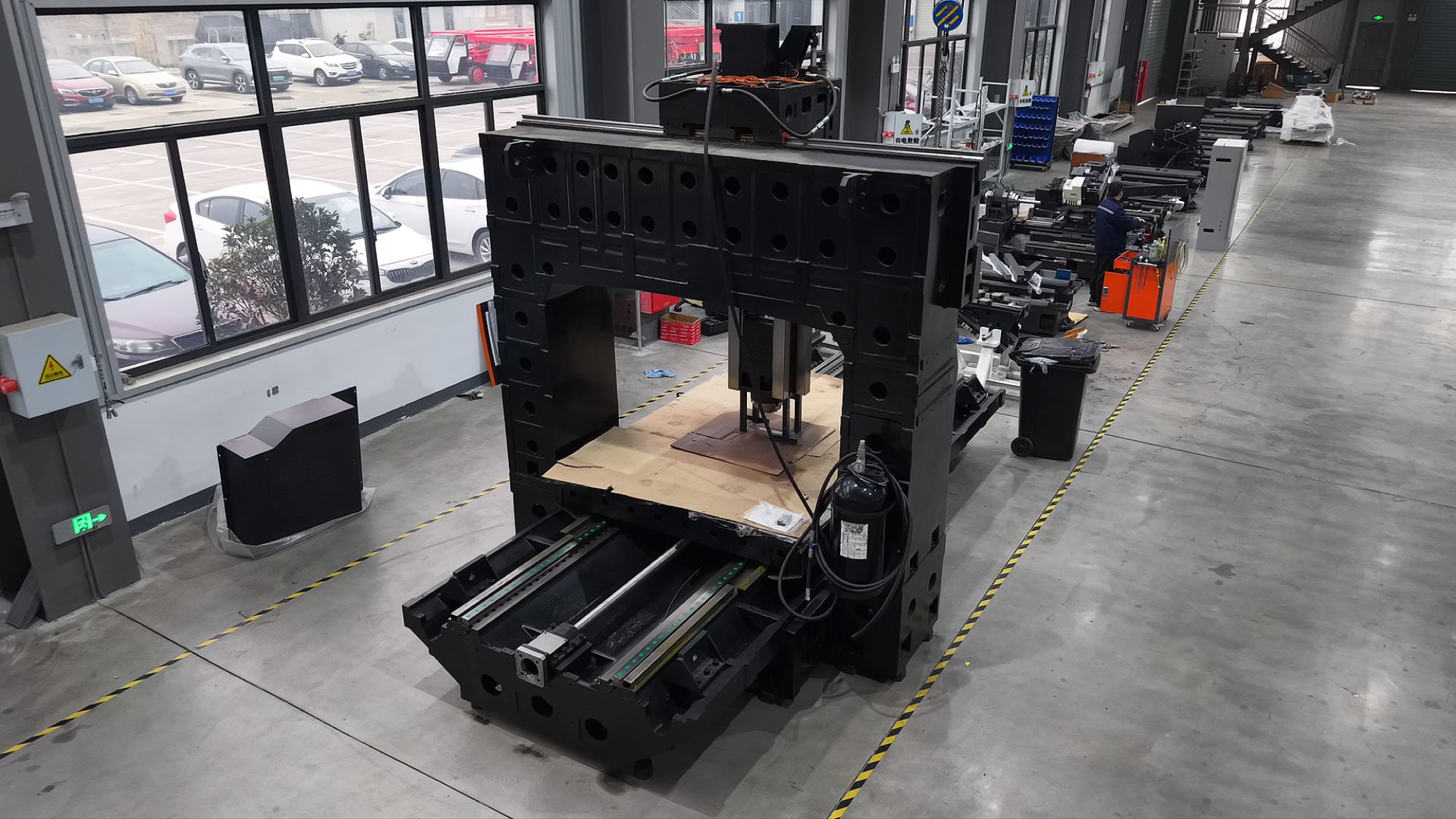
Every gantry system encounters unique demands, and off-the-shelf solutions rarely deliver the stiffness required for precision-critical tasks. Custom gantry design begins by dissecting your specific load paths, acceleration profiles, and spatial constraints. Instead of forcing a generic frame to fit, we engineer the structure from the ground up—adjusting beam profiles, reinforcing node connections, and selecting materials that inherently resist deflection. The result is a structure that maintains its geometry under dynamic loads, eliminating the subtle flex that undermines accuracy over time.
Achieving maximum rigidity isn’t just about adding mass; it’s about intelligent distribution. Using iterative finite element analysis, we identify stress concentrations and reshape sections to redirect forces efficiently. Welded joints are designed with smooth transitions to avoid stress risers, while precision-machined mounting surfaces ensure perfect alignment. Every rib, gusset, and cross-member serves a purpose—none are decorative. This approach not only stiffens the structure but often reduces weight compared to brute-force overbuilding, yielding a faster, more responsive system without sacrificing stiffness.
In demanding environments like high-speed machining or laser contouring, where tool-to-workpiece relationships must stay within microns, a tailored gantry becomes a competitive advantage. The tight coupling between design and application means less resonance, quicker settling times, and predictable thermal behavior. Operators notice the difference immediately: smoother motion, sharper corners, and less compensation in software. Ultimately, a custom gantry isn’t just a frame—it’s the foundation of repeatable precision, built to keep your process on the cutting edge without constant recalibration.
Boosting Productivity Through Adaptive Machining Strategies
Adaptive machining transforms static CNC operations into dynamic, self-adjusting processes that respond to real-time conditions. By integrating sensor feedback and machine learning, toolpaths and cutting parameters are continuously optimized mid-operation. This live recalibration drastically reduces cycle times and waste, turning unpredictable variables like tool wear or material inconsistencies into managed factors rather than production stoppers.
Shops leveraging adaptive strategies report notable gains in spindle utilization without sacrificing quality. The technology automatically adjusts feeds and speeds to maintain ideal chip loads, preventing chatter and tool breakage before they occur. Operators shift from constant monitoring to higher-level oversight, while smart algorithms handle micro-corrections that would be impossible to gauge manually. The result is not just faster throughput but a more resilient workflow that accommodates design tweaks or mixed batches with minimal reprogramming.
Beyond immediate output gains, adaptive machining extends tool life and lowers per-part costs. Real-time adjustments minimize unnecessary cutting forces, reducing stress on spindles and cutting edges. This leads to fewer tool changes and more consistent surface finishes, even in demanding materials. When planned maintenance aligns with actual tool condition data rather than fixed intervals, unplanned downtime becomes rare, allowing production schedules to run reliably with less buffer stock.
Mastering Vibration: The Key to Reliable Heavy-Duty Accuracy
In heavy machinery, even the slightest vibration can quietly eat away at precision. Over time, what starts as a minor tremble in a bearing or a gear mesh can cascade into misalignment, uneven wear, and costly dimensional errors. Operators often overlook these early signs, but the truth is that vibration isn't just noise—it's a direct threat to the repeatability and accuracy that heavy-duty applications demand. If you can't control it, you can't trust the cut, the position, or the measurement.
Mastering vibration starts with understanding its source. It might be an imbalanced rotor, a failing coupling, or even the resonant frequency of the floor the machine sits on. Rather than chasing symptoms, a targeted approach—using sensors to map out vibration patterns, then isolating or damping the root causes—turns guesswork into a disciplined practice. In many cases, simple changes like adjusting bolt torque, switching to polymer composite foundations, or fine-tuning spindle speeds can yield a dramatic improvement in stability.
When vibration is brought under control, the payoff is immediate and tangible. Tool life extends, surface finishes improve, and tolerances tighten without constant adjustment. More importantly, the machine runs reliably through long shifts, holding specs that would otherwise drift. This level of consistency isn't just about numbers on a report—it's what separates a workshop that fights breakdowns from one that delivers quality without surprises.
Automation Integration for Seamless Large-Part Production
Bringing robots, vision systems, and adaptive tooling together on the factory floor transforms how oversized components move from raw stock to finished assembly. Instead of isolated machining cells, the entire workflow is choreographed so a welding station can signal a downstream buffer when it’s ready for the next frame segment, while gantry loaders automatically adjust grip patterns based on real‑time metrology feedback. The result is a rhythm that keeps material flowing without manual intervention, eliminating the usual pauses and misalignments that plague large‑scale fabrication.
One of the hidden challenges with massive parts is the sheer number of interfaces — between different machine controllers, legacy equipment, and quality‑inspection databases. A modern integration layer translates proprietary protocols into a unified data stream so a laser tracker’s measurements can recalibrate a milling head mid‑cycle or alert a technician’s tablet before a tolerance drifts out of spec. This tight digital handshake means the production line can self‑correct in ways that rigid recipes never could, absorbing minor variations in material batches or tool wear without slowing down.
Operators also benefit from a clear, role‑based window into the process. Instead of staring at cryptic status lights, they see a dashboard that highlights only the exceptions — a weld seam that needs visual verification or a pallet that reached its maintenance interval. For large‑part runs where one scrap piece can erase days of margin, combining automated decision logic with human oversight turns complexity into a manageable, repeatable rhythm. The entire plant behaves more like a single, responsive machine rather than a collection of disconnected tools.
Long-Term Performance: Engineering Gantry Centers to Evolve
Gantry systems designed for sustained heavy use must anticipate more than just initial load requirements. The steel framework and drive mechanisms are configured with modularity in mind, allowing bearings, rails, and motors to be swapped or upgraded without a full rebuild. By overbuilding core structural components and leaving clearance for future enhancements, these centers stay productive decades after installation.
Software plays an equally central role in longevity. Control architectures are decoupled from proprietary hardware, letting operators update motion profiles, integrate new sensors, or adapt to different materials as workflows change. Rather than locking users into a fixed capability set, the logic layer accepts periodic refinement, extending the machine's relevance long past the typical depreciation window.
Environmental hardening also factors into the lifespan equation. Sealed cable carriers, corrosion‑resistant coatings, and thermal compensation routines shield precision components from coolant, shop debris, and temperature swings. This layered protection means the gantry continues holding tight tolerances even as the surrounding facility evolves, making it a stable foundation for advancing manufacturing processes.
FAQ
Custom gantry machining centers offer tailored structural rigidity and extended travel ranges, which directly enhance accuracy on oversized parts while minimizing setup time and boosting overall throughput.
By engineering the frame, spindle, and motion components to match the exact workpiece demands, you eliminate the compromises of off-the-shelf machines, resulting in tighter tolerances and better surface finishes over long cycles.
Absolutely. Modern designs integrate quick-change fixturing and adaptive tooling stations, allowing seamless switchovers between low-volume, high-mix jobs and repetitive large-part runs without recalibration delays.
High-speed CNC controls with look-ahead algorithms and dynamic collision avoidance optimize cutting paths and reduce non-cutting time, turning complex multi-axis operations into smooth, rapid sequences.
In many cases, yes. Retrofitting with high-performance spindles, servo drives, and updated control systems can close the accuracy gap, but ground-up custom builds inherently provide deeper optimization for emerging part geometries.
Tailored configurations often simplify access to wear components and integrate condition-monitoring sensors, turning scheduled maintenance into predictable, short interventions that prevent unplanned downtime.
Conclusion
In truly large-scale machining, standard equipment often falls short when tolerances tighten and workpiece masses reach dozens of tons. Custom gantry machining centers step into this gap by integrating structures engineered from the ground up for extreme stiffness. Rather than relying on generic castings, these frames are tailored—thicker ribbing, optimized cross members, and selectively damped joints—to suppress deflection under heavy cuts. That structural integrity is then paired with adaptive machining algorithms that continuously read spindle loads and tool deflection in real time, dynamically adjusting feed rates and tool paths to hold precision far beyond typical catalog specs. Even subtle floor vibrations and chatter patterns are countered through active damping systems and model-based servo tuning, turning the machine’s own mass into an ally for consistent, heavy-duty accuracy.
Productivity gains in large-part work don’t come from raw speed alone; they emerge when automation and intelligent process planning eliminate downtime. These gantry solutions embed pallet shuttles, robotic tool changers, and in-process probing into a unified workflow, allowing lights-out production of multi-ton components like ship engine blocks or wind turbine hubs. Looking further ahead, the machines are conceived as evolving platforms: modular spindle interfaces, upgradeable control architectures, and fields for future sensor integration mean capacity can grow with changing part families. This strategic blend of tailored rigidity, adaptive control, vibration mastery, and thoughtful automation ensures that custom gantry centers consistently deliver the accuracy and throughput that large-scale manufacturers require—without ever becoming obsolete.
Contact Us
Contact Person: Tim
Email: [email protected]
Tel/WhatsApp: +86 15522553731
Website: https://www.winnrui-cnc.com/