
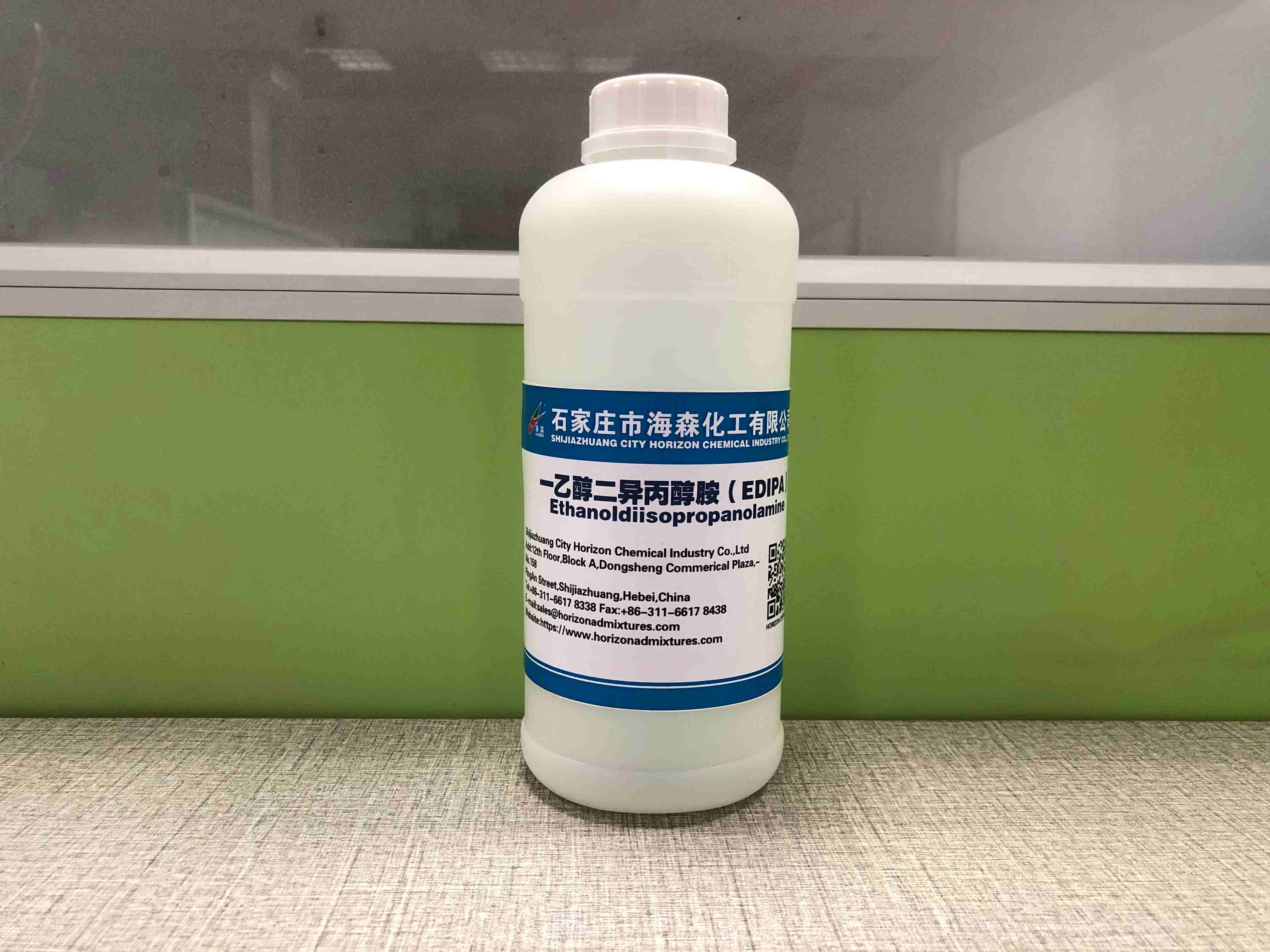
Ethanoldiisopropanolamine: Key Industrial Applications and Benefits
2026-08-17
Ethanoldiisopropanolamine (EDIPA) rarely grabs headlines, yet it quietly powers essential processes across industries—from cement grinding aids to metalworking fluids. If you’ve ever wondered why some concrete pours finish smoother or certain coatings resist corrosion better, this multifunctional alkanolamine likely plays a role. In this post, we’ll break down its key industrial applications and the tangible benefits it delivers. At HAISEN, we’ve seen firsthand how the right EDIPA formulation can boost efficiency and product performance—often in ways that surprise even seasoned engineers. Read on to discover where this unsung chemical workhorse fits into your world.
Why Ethanoldiisopropanolamine Keeps Showing Up in Industrial Formulas
Ethanoldiisopropanolamine sits in a sweet spot between small volatile amines and bulky alkanolamines. Its molecular structure gives it enough water solubility to stay in the aqueous phase, but the branched isopropanol groups hinder over-quick evaporation and reduce the sharp odor that often comes with monoethanolamine. For a formulator, this means fewer headaches in the mixing room and a longer working window on the production floor.
In metalworking fluids and alkaline cleaners, the compound quietly does several jobs at once. It buffers pH without spiking, helps emulsify oils that would otherwise separate, and shows lower corrosion toward copper and aluminum than many of its simpler cousins. Replacing it would often require adding two or three separate ingredients, which complicates the formula and raises the bill of materials.
There is also a practical inertia at play. Once a plant has tuned its pumps, filters, and waste treatment around a specific amine, switching to an alternative is rarely worth the risk. Suppliers keep the price stable, quality consistent, and the regulatory paperwork manageable. In industrial chemistry, that kind of boring reliability is exactly why a compound keeps showing up year after year.
Coatings and Inks: The Hidden Workhorse Behind Film Integrity
Most of the attention goes to the base film, but the layers printed or coated onto it often decide whether the material actually performs. A polyester or polypropylene web may be clear and tough, yet without a receptive coating, water-based ink will simply bead and smear. The right primer changes surface energy just enough to lock pigments in place and survive downstream heat sealing.
Barrier requirements push coatings even further. A few microns of PVdC or a nanocomposite layer can cut oxygen transmission to levels that keep snacks crisp or medical devices sterile. Inks carry similar demands: they must not crack when the film is folded, must resist alcohol or pasteurization, and must stay put during high-speed form-fill-seal operations. Binder selection, pigment dispersion, and additive packages are tuned far beyond what a simple color layer would need.
Production tolerances are equally unforgiving. Coating weight, viscosity, drying temperature, and web tension all interact; drift too far in one direction and you get blocking on the reel or patchy print adhesion. When everything is dialed in, though, these layers work invisibly—until someone tries to remove them or substitute a cheaper alternative.
Cleaners and Degreasers That Pull More Weight at Lower Dosages
In many facilities, the assumption still lingers that a stronger pour means a cleaner surface. Yet modern formulations have flipped that logic on its head. The latest generation of cleaners and degreasers relies on advanced surfactants and solvent blends that activate quickly, penetrate grime at the molecular level, and lift away stubborn residues without demanding heavy dilution. This means a half-ounce per gallon can often outperform older products dosed at full strength, reducing both chemical waste and the physical strain on maintenance teams.
What makes these low-dosage formulas stand out is their ability to stay effective across a wider range of soils, from baked-on carbon in kitchens to hydraulic fluid on workshop floors. The key lies in the synergy between chelating agents and emulsifiers, which break the bond between dirt and substrate instead of simply flooding the area with solvent. As a result, users see fewer passes with a mop or cloth, less residue left behind, and a noticeable drop in re-soiling rates. That translates into real savings—not just in product cost, but in labor hours and water usage as well.
For buyers and facility managers, the shift to concentrated, high-efficiency cleaners requires a small adjustment in habits: measuring rather than glugging. But once that practice is in place, the benefits compound quickly. Shelves hold fewer bulky jugs, storage footprints shrink, and the risk of over-application—which often leaves sticky films that attract more dirt—diminishes. The best part is that these products don't ask you to sacrifice power for prudence. They simply prove that in the world of industrial and commercial cleaning, pulling more weight at lower dosages is no longer a compromise, but a competitive advantage.
Metalworking Fluids: Corrosion Control Without Extra Additives
Machine shops often reach for a bottle of corrosion inhibitor the moment rust appears on a freshly ground part. Yet many modern metalworking fluids are already formulated with enough built-in protection to keep iron and steel surfaces clean through the entire machining cycle—if the fluid is maintained properly. The key is not adding more chemistry but managing concentration, pH, tramp oil, and contamination. A well-kept soluble oil or semi-synthetic at the right refractometer reading creates a thin, continuous film that blocks oxygen and moisture from reaching the metal. When operators chase rust with extra additives, they can upset the emulsion balance, leading to sticky residues, foaming, or even worse corrosion under the film.
Chlorides and sulfates from hard water or poor-quality make-up water are often the real culprits behind flash rusting, not a lack of inhibitor. Instead of pouring in more rust preventive, shops should test the mix water and switch to deionized or reverse-osmosis water if mineral levels are high. Regular skimming of tramp oil and removal of fines also matters: a dirty sump with floating oil creates anaerobic pockets that produce corrosive acids. By keeping the fluid clean, aerated, and within the recommended concentration band—usually 5% to 8% for light machining—the existing corrosion package can work as designed. Adding extra additives on top of a healthy fluid often masks a maintenance problem rather than solving it.
For operations running long overnight shutdowns or storing parts between operations, a slight bump in concentration within the recommended range often provides better protection than any third-party additive. Spraying a light coat of the same fluid mixed at the higher end of its range on finished surfaces before racking them can prevent rust without introducing incompatible chemistry. This approach avoids the common failure of mixing two different inhibitor packages that end up neutralizing each other. In most cases, the simplest corrosion control is already in the drum—proper mixing, clean water, and consistent concentration let the fluid protect the metal as it was designed to do.
pH Buffering That Stays Predictable Across Temperature Swings
Many buffer systems drift noticeably when the lab heats up or cools down, but this one holds its pH within a tight range regardless of ambient shifts. The formulation relies on a carefully balanced pair of buffering agents whose pKa values move in opposite directions as temperature changes, effectively cancelling out the thermal effect. That means you can run a calibration at 20°C, then move to a 30°C incubator without recalibrating or second-guessing your readings.
What sets this buffer apart is not just the chemistry, but the predictability it brings to workflows. You won't see the slow acidification that plagues tris-based systems on a warm afternoon, nor the alkaline creep that some phosphate buffers show in cold rooms. Instead, the pH remains stable enough that long-term experiments stay consistent from morning to night and across seasons.
For anyone who has struggled with temperature-sensitive assays or enzyme reactions that suddenly behave differently at 28°C versus 25°C, this buffer removes one more variable from the equation. It lets you focus on the biology rather than constantly chasing pH drift with manual adjustments or extra control samples.
From Lab Scale to Production: What to Watch When You Switch
Moving from a bench-top beaker to a pilot reactor rarely feels like a simple multiplication. Heat removal, mixing efficiency, and the surface-to-volume ratio all shift in ways that quietly invalidate lab observations. An exotherm that was easy to quench with an ice bath can overwhelm a jacketed vessel, and a five-minute stir in a flask may become thirty minutes of dead zones in a poorly baffled tank. Run a few scale-down experiments with the actual production geometry in mind before locking any process parameters.
Raw materials also deserve a hard look. The high-purity reagents from a lab catalog often get replaced by technical-grade feedstocks that carry trace metals, moisture, or isomer distributions nobody checked. These impurities can poison a catalyst, shift selectivity, or nucleate precipitation at exactly the wrong point. Qualify at least two supplier lots at pilot scale and update analytical methods to handle the messier sample matrix—your current HPLC method may not survive contact with production slurries.
Finally, pay attention to the invisible work: sampling, data recording, and operator intervention. In the lab you can tweak pH by hand and note it on a scratch pad; in production that becomes a procedural deviation waiting to happen. Identify which parameters actually control the outcome and automate or at least alarm them early. Cleaning and waste handling also change scale in nonlinear ways, so involve the plant team before you discover that your solvent recovery plan assumes a distillation column that does not exist.
FAQ
It combines the alkalinity of a secondary amine with a lower tendency to form stable carbamates, which allows for easier regeneration. Ethanol in the blend also reduces viscosity and improves mass transfer, making it suitable for CO2 and H2S scrubbing at moderate pressures.
Unlike MEA, it resists thermal degradation at higher stripper temperatures and has a lower regeneration energy requirement. Compared with DEA, it often achieves similar acid gas loadings while being less corrosive to carbon steel equipment.
Natural gas processing, refinery off-gas treating, and ammonia plants are major users. It also appears in specialty cleaners, metalworking fluids, and some agrochemical formulations where a mild alkaline buffer and solvent are needed.
The ethanol acts as a co-solvent that lowers freezing point and improves pumpability in cold climates. It also enhances the solubility of organic sulfur compounds and trace hydrocarbons, helping prevent emulsion formation in contactors.
Yes, the ethanol component helps maintain a stable pH and can mitigate localized attack by reducing chloride concentration at metal surfaces. Some operators also note lower iron pickup in lean/rich exchangers compared with conventional MEA systems.
It provides good wetting and emulsification of oily soils, works well in hard water, and leaves minimal residue on surfaces. Because it is a relatively mild amine, it can be formulated into industrial degreasers without the harsh odor of ammonia-based cleaners.
Store in sealed stainless steel or lined carbon steel tanks away from strong oxidizers and acids. Use nitrogen blanketing to prevent moisture uptake and keep product temperatures below 40°C to maintain color stability.
Conclusion
Ethanoldiisopropanolamine keeps resurfacing in industrial formulas because it rarely does just one job. In coatings and inks, it stabilizes film formation under shifting humidity and cure conditions, preventing micro-cracking and haze that would otherwise call for rework. The same molecule shows up in cleaners and degreasers, where a relatively small addition boosts soil suspension and speeds up emulsification of stubborn oils. Formulators like that it earns its place without forcing them to raise overall solids or solvent content. Metalworking fluids benefit too: the compound's affinity for metal surfaces creates a protective layer that slows corrosion, reducing the need for separate inhibitor packages and simplifying inventory.
What often goes unnoticed is how well it holds pH steady across wide temperature swings, a property that keeps emulsion stability and additive performance predictable from cold startups to hot machining runs. If you are moving from lab scale to production, pay attention to mixing order, viscosity changes, and the fact that this amine can interact with certain anions, so small batch checks still matter. The real advantage is not any single feature but the way it bundles film integrity, cleaning power, and corrosion control into one low-dosage ingredient. That is why ethanoldiisopropanolamine continues to replace more specialized additives in cost-sensitive and performance-driven formulations.
Contact Us
Contact Person: Sam Lee
Email: [email protected]
Tel/WhatsApp: 86-311-6617 8338
Website: https://www.horizonadmixtures.com/