
Walking Beam Quenching and Tempering Production Line for Oil Well Pipes Built for Export
2026-09-09
When a major overseas order demanded more than standard heat treatment, we didn’t just ship machinery—we engineered certainty. The walking beam quenching and tempering line for oil well pipes, built specifically for export, had to survive the toughest logistics and the harshest downhole conditions. How do you guarantee uniform mechanical properties in every joint, from casing to tubing, when the line itself crosses oceans before it ever heats steel? That’s the question behind this project, and the reason THINKING-LONG approached it not as a sale, but as a promise. In this post, we pull back the curtain on the design choices, the hidden pitfalls of export compliance, and one unconventional test that almost didn’t make it past our own engineers. If you’ve ever wondered what separates a line that merely works from one that keeps working under pressure—literally—read on.
Walking Beam Motion That Keeps Thin-Wall Oil Country Tubulars From Bowing
Thin-wall oil country tubulars are notoriously prone to bowing during handling and processing, especially when they come off the cooling bed or move through a straightening line. A walking beam motion offers an elegant fix. Instead of dragging or rolling the pipe across fixed supports, the walking beam lifts each tube slightly, carries it forward in a synchronized arc, and then sets it down gently on the next cradle. This vertical lift-travel-lower cycle removes the continuous lateral friction that causes long, slender tubes to flex under their own weight. The result is a straight, stress-free transfer that preserves wall thickness uniformity and keeps the pipe from developing a permanent set.
What makes the walking beam approach particularly effective for thin-wall OCTG is the way it distributes support along the entire length of the tube. Unlike conventional chain or roll conveyors that contact the pipe at discrete points, the beam’s profiled pads or cradles contact a generous arc of the pipe’s outer diameter. This broader contact patch reduces localized bending moments, so even a 0.188-inch wall casing won’t sag between supports. Operators can tune the beam’s stroke length and lift height to match the pipe’s stiffness, and in some systems the lift is phased to occur only while the pipe is fully supported at both ends. That eliminates the mid-span deflection that triggers bowing in the first place.
Field reports from tube mills running high-collapse casing and slim-hole drill pipe confirm the walking beam’s value beyond just preventing bowing. With fewer straightening operations required downstream, internal stresses stay low, which matters for sour-service grades where residual stress can accelerate sulfide stress cracking. The gentle motion also cuts down on surface damage—no more peening marks from chain dogs or roll chatter on the pipe body. For a mill chasing API 5CT dimensional tolerances, that translates into less end trimming, fewer rejects, and a smoother handoff to the hydrotester or ultrasonic inspection line.
Inside the Quench Tank Design That Restores Compressive Stress
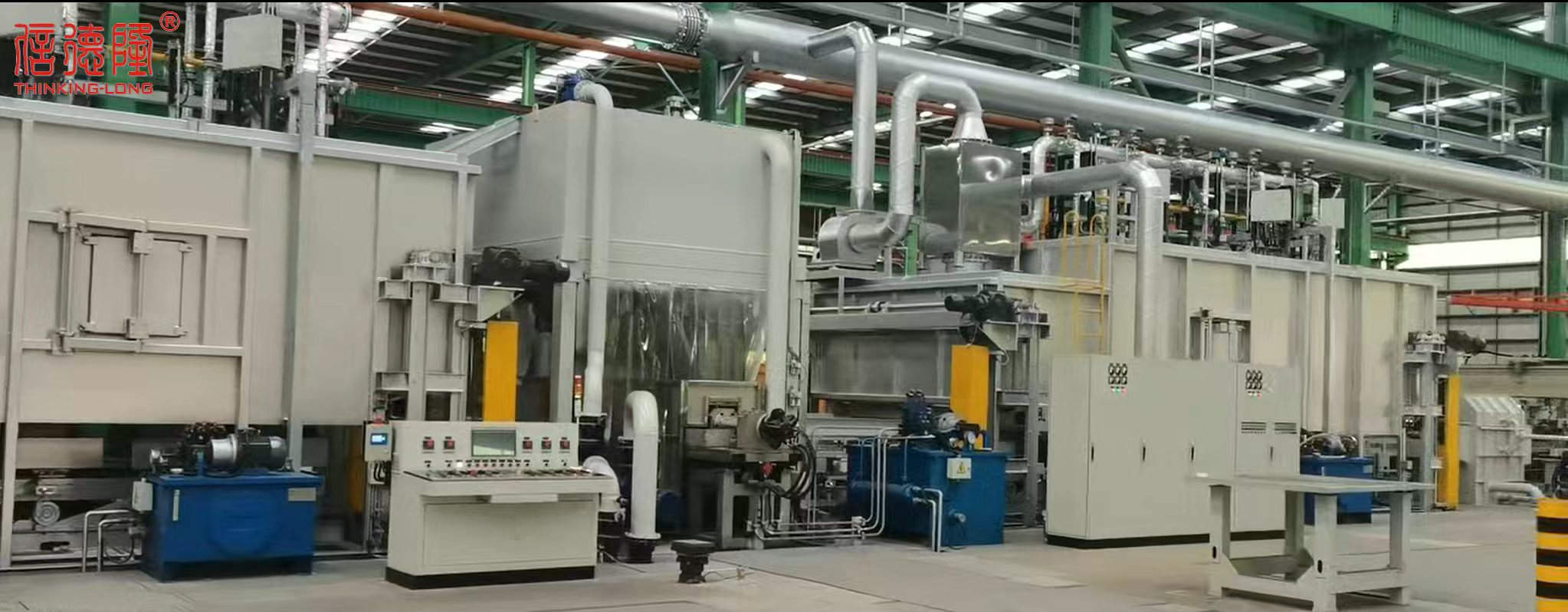
Quench tank design has moved far beyond the simple agitated bath. The current focus sits on directed flow fields that pull heat from the part surface at a controlled rate. By positioning submerged nozzles and adjustable baffles, the tank can create a uniform thermal gradient through the cross-section, which is the first step in converting surface tensile stress into a compressive layer.
What matters most is the timing of the martensite transformation. If the core and surface cool at mismatched rates, the surface contracts before the core has finished expanding, leaving residual tension. The redesigned tank keeps the quenchant velocity and temperature within a narrow window during the critical transformation range, so the surface hardens first and then gets squeezed by the still-contracting core. That mechanical squeeze is what locks in compressive stress.
Some shops now use variable-speed impellers and real-time temperature sensing to adjust the flow pattern on the fly. A part with thicker sections might get a higher flow rate aimed at those zones, while thin edges are shielded from excessive turbulence. The result is less distortion, deeper compressive stress, and a fatigue life that often doubles compared to parts quenched in older, one-size-fits-all tanks.
How the Tempering Furnace Holds Soaking Time Within Five Seconds
The tempering furnace achieves such tight soaking time control through a closed-loop temperature feedback system that samples the chamber every few milliseconds. Instead of waiting for a thermostat to trip, the controller continuously compares actual temperature against the setpoint and adjusts power output in real time. This prevents the typical drift and correction cycle that adds seconds to the holding phase.
Heating elements made from low-thermal-mass materials like thin molybdenum foils or silicon carbide ribbons respond to voltage changes almost instantly. When the controller dictates a stop, heat delivery ceases within a few milliseconds. There is no residual glow or slow cooling of bulky elements to cause overshoot, so the load settles at the target temperature and stays there without needing extra stabilizing time.
Airflow inside the chamber is engineered to eliminate temperature gradients before they can form. A high-velocity circulation fan combined with carefully positioned baffles forces uniform heating across the entire load. Every part reaches the setpoint simultaneously, meaning the furnace doesn't wait for cold spots to catch up or hot spots to cool down. That uniformity is what makes a sub-five-second soaking period practical rather than just theoretical.
Export-Ready Control Architecture for 50Hz and 60Hz Power Grids
Modern control architectures no longer treat 50Hz and 60Hz as separate design constraints. By using a configurable reference frequency generator and an adaptive phase-locked loop, the same control hardware can switch between the two grid standards without changing the core firmware. The key is to work entirely in per-unit values for sampling, filtering, and droop control so that the frequency difference does not alter loop gains or dynamic response.
For export scenarios, grid compliance certification often delays delivery. This architecture stores grid code parameters as loadable configuration files, covering frequency change rate limits, reactive power support curves, and low-voltage ride-through thresholds. Field engineers only need to import the target market's specification file through a secure interface, with no firmware recompilation required. Hardware-in-the-loop testing covers both 50Hz and 60Hz fault conditions, allowing most certification pre-tests to be completed before shipment.
Another often overlooked difference lies in transformer and magnetic component saturation behavior. A 50Hz transformer operated at 60Hz shows reduced magnetizing current but altered core loss and acoustic noise characteristics. The control architecture compensates by adjusting sensor calibration and dead-time compensation parameters, preventing DC offset or harmonic instability after a frequency switch. Built-in frequency detection automatically loads the matching parameter set from memory.
What Buyers in the Middle East and Southeast Asia Ask Before Signing
Buyers across these regions rarely open with price. Their first questions usually revolve around proof of reliability and local market fit. A distributor in Dubai might ask for references from other Gulf Cooperation Council clients, while a procurement manager in Jakarta wants to see how the product handles high humidity and fluctuating voltage. They are not just checking boxes; they are testing whether you understand the operating conditions their teams face every day.
Payment and delivery terms get scrutinized in ways that can surprise first-time exporters. Questions about letters of credit, flexible payment windows tied to port clearance, and who bears the cost of demurrage are common. In Southeast Asia, where logistics across islands can add weeks, buyers often ask for realistic lead times and buffer stock agreements rather than theoretical shipping estimates.
After-sales commitments matter as much as the initial product spec. Buyers want to know who will handle warranty claims, whether spare parts are stocked locally, and how quickly a technician can reach their facility. In the Middle East, a question about service response time may be phrased as a demand for a named account manager; in Vietnam or Thailand, the same concern shows up as a request for training materials in the local language.
Why Sour Service Grades Demand a Different Quench and Temper Recipe
Sour service materials are exposed to wet H2S, where hydrogen atoms can enter the steel and promote sulfide stress cracking. Standard quench and temper practices often leave a mixed microstructure of martensite, bainite, and even some ferrite, along with high residual stresses from aggressive quenching. In sour environments, these features act as hydrogen traps or crack initiation sites. A sour service grade therefore requires a more tightly controlled quench: often using a slower or interrupted quench medium, ensuring full through-hardening without excessive thermal shock, and then tempering at a sufficiently high temperature to reduce hardness below the NACE MR0175/ISO 15156 limits—typically HRC 22 max for carbon and low-alloy steels. This higher tempering temperature transforms the as-quenched martensite into a more stable, lower-stress tempered martensite, reducing both hardness and the density of high-energy dislocation networks where hydrogen can accumulate.
Another key difference is the need to avoid untempered martensite and to refine prior austenite grain size. In sour service, even small amounts of fresh martensite from inadequate tempering can create local hard spots that fail under hydrogen charging. Adjusting the quench and temper recipe often means choosing alloy chemistries with higher temper resistance, so the required strength can be achieved after prolonged tempering without sacrificing toughness. Additionally, the tempering time may be extended or a double temper performed to ensure uniform softening and to decompose any retained austenite, which otherwise transforms to untempered martensite in service. The result is a microstructure with lower hardness, fewer residual stresses, and a more homogeneous distribution of fine carbides—all critical for resisting sulfide stress cracking.
FAQ
It processes oil well pipes such as casing, tubing, and drill pipe through continuous heating, quenching, and tempering stages to achieve the mechanical properties required for downhole service.
The walking beam lifts and advances each pipe in a stepwise motion, minimizing surface contact and preventing skid marks or uneven heating. It also enables precise indexing and better temperature uniformity across the full pipe length.
Oil well pipes must withstand high internal pressure, corrosive fluids, and mechanical stress. Quenching rapidly cools the steel to harden it, then tempering reduces brittleness and restores toughness so the final pipe meets demanding API grades like P110 or Q125.
The line uses modular construction to simplify shipping and on-site installation, complies with common international standards, and includes energy-efficient burners plus remote diagnostics. The control system supports multiple languages and adjustable voltage and frequency specifications for different regions.
Yes, adjustable walking beam pitch, variable speed drives, and quick-change quench rings allow it to run a broad range from small-diameter tubing to large casing. Changeover usually relies on stored recipes and motorized adjustments instead of manual rebuilds.
The line combines internal and external spray quenching with high-pressure water or polymer, while the pipe rotates or shifts during cooling to avoid steam blanket formation and ensure uniform cooling along the entire length and through the wall thickness.
A PLC-based automation system with HMI screens tracks each pipe's position, temperature profile, and quench timing. Data logging supports traceability and integration with a plant MES, while safety interlocks prevent overheating or improper handling.
Support typically includes remote troubleshooting, on-site commissioning by experienced engineers, spare parts packages, and operator and maintenance training. Some suppliers also offer performance guarantees tied to production throughput and final pipe quality.
Conclusion
Walking beam quenching and tempering lines built for oil well pipes destined for export must handle two realities that domestic units rarely face: thin-wall oil country tubular goods that bow under aggressive handling, and buyers who scrutinize every thermal cycle before they sign. The walking beam motion itself is tuned to lift and advance without imposing lateral force on the pipe body, which keeps 0.156-inch wall OCTG straight through the austenitizing furnace. Inside the quench tank, water flow is directed through an internal spray ring rather than a simple immersion bath, restoring compressive stress on the outer surface while preventing steam pockets that cause uneven hardness. This matters because export clients in the Middle East and Southeast Asia routinely ask about residual stress, not just hardness values.
The tempering furnace uses a cascaded zone control with a moving thermocouple array to hold soaking time within five seconds of setpoint, even when the line speed shifts between 50Hz and 60Hz power grids. Export-ready control architecture isolates variable frequency drives and heating elements on separate buses so a frequency change does not drift the furnace profile. Sour service grades like C95 and T95 require a different quench and temper recipe: lower austenitizing temperature, faster quench to below the martensite finish temperature, and a longer temper at a lower temperature to avoid tempered martensite embrittlement. Buyers from ADNOC or PTTEP often ask for evidence of this recipe before approving a line for H2S service. Combining these elements in one walking beam line gives export-oriented pipe mills a production unit that holds straightness, surface stress, and soak time within the narrow windows that API 5CT and NACE MR0175 demand, without needing a separate straightening press or post-quench stress relief.
Contact Us
Contact Person: Qian Xijun
Email: [email protected]
Tel/WhatsApp: 8613961736750
Website: https://www.thinkinglong.com/